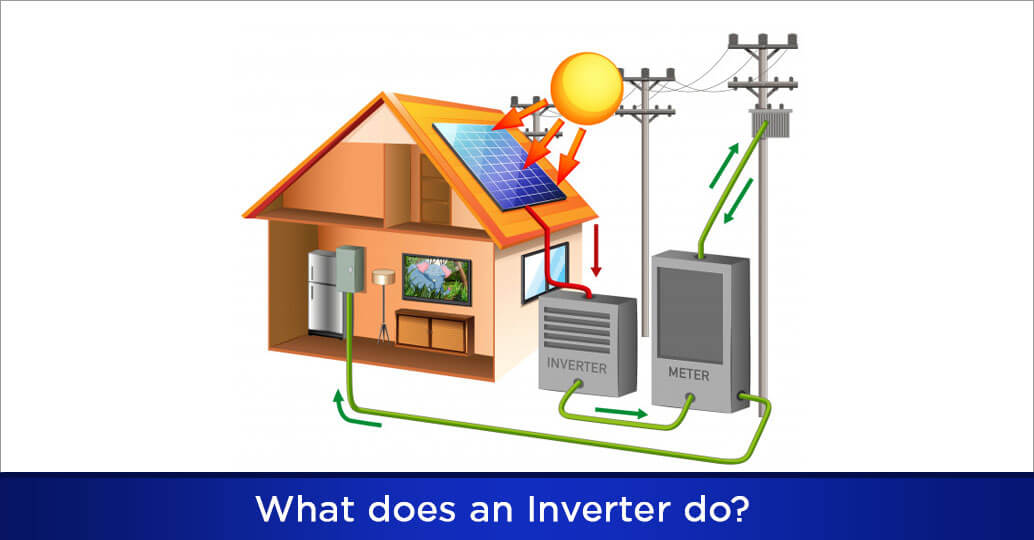
What does an Inverter do?

What is an inverter?

An inverter or power inverter is a device that converts the direct current (DC) to alternating current (AC) at the required frequency and voltage output. The inverter might be worked as an independent equipment for applications, such as, solar power, or as a backup power supply from batteries which are charged separately. The other configuration is at which it is a part of a bigger circuit, for example, a power supply unit, or a UPS. In this situation, the inverter input DC is from the rectified mains AC in the PSU, while from either the rectified AC in the UPS when there is a power and from the batteries when there is a power failure.

There are various kinds of inverters based on the shape of the waveform. These have varying by circuit designs, efficiencies, advantages and disadvantages. A simple and common use of inverter is the solar inverter. It converts direct current (DC) from a PV solar panel to alternating current (AC) that can be fed into the electrical grid. The AC power is used for home appliances.

Type of inverters

According to the output characteristics, there are three types of inverters:

Square Wave Inverter, Sine Wave Inverter, Adjusted Sine Wave Inverter

1) Square wave inverter

The output waveform of the voltage for this inverter is a square wave. This kind of inverter is least utilized among other sort of inverter because all appliances are intended for sine wave supply. If we supply square wave to sine wave based appliances, it might be damaged. Square wave inverter is extremely low cost inverter but the application is rare. It is usually used to support universal motors.

2) Sine wave Inverter

The output waveform of the voltage for this inverter is a sine wave and it gives us similar output like utility supplied electricity. The appliances which we’re using, these are designed for Sine wave. This is the appropriate output and gives guarantee that equipment will work properly. Sine wave inverter is expensive but it widely used in residential and commercial applications.

3) Modified sine wave Inverter

The output waveform of Modified sine wave inverter is neither exact sine wave nor the square wave. Modified sine wave inverter is complex than Square wave inverter but easier than Sine wave inverter. It is affordable and generally useful inverters. Using more basic type of technology than pure sine wave inverters, they produce power which is adequate for simple electronics. Modified sine wave inverter is used to provide power for your less sensitive appliances like telephone chargers, heaters and air conditioners etc.

How does the inverter work?

The basic circuits include an oscillator, control circuit, drive circuit for the power devices, switching devices, and a transformer.

The conversion of dc to alternating voltage is accomplished by converting energy stored in the dc source into an exchanging voltage. This is done by using switching devices which are turned on and off continuously, and afterward stepping up using the transformer. There are a few configurations which don’t use a transformer, these are not generally used.

The DC input voltage is turned on and off by the power devices, for example, MOSFETs or power transistors and fed to the primary side of the transformer. The changing voltage in the primary induces an alternating voltage at optional winding. The transformer works as an amplifier also where it expands the output voltage ratio determined by the turn’s ratio. The output voltage is increased from the standard 12 volts provided by the batteries to either 120-240 volts AC in most cases.

The three most commonly used Inverter o/p stages are, a push-pull with center tap transformer, push-pull half-bridge, or push-pull full bridge. The push pull with central tap is most popular because of its effortlessness and guaranteed results. Heavier transformer has been used for this and produces a lower efficiency.

How does an inverter can work with solar panels?

The Solar Inverter converts the solar panel generated direct current (DC) to alternating current (AC) in form of electricity. Different types of electrical and electronic components are connected each other within in the circuit to help in the conversion.

Sometimes we can use the direct current produced by Solar Panel for Solar lights, cell phone charger etc. But most of the time people used to convert the DC power to AC power for running the general applications live Refrigerators, TVs, etc. to reduce the general electricity bills.

Solar energy is changed to electrical energy with the help of photovoltaic cells (PV) solar energy is converted into electrical energy during the daytime. This electrical energy is stored in batteries & used for different purpose in future.

While converting the DC (Direct Current) output by a solar inverter of a photovoltaic solar panel into a utility frequency AC which will be used in commercial grid.

In the solar energy power system, the DC power from PV cells is stored in the battery. After that, using the PWM inverter IC with MOSFET the energy stored in battery is converted into AC power supply of 50Hz.

Most commonly used Solar Inverter available in Australia

SolarEdge Single Phase Inverter: World record setting solar manufacturer with high efficiency and reliability. Perfect for all challenging weather conditions. Maximum AC Power Output with Residual Current Detector.

KEHUA Inverter (SPI-B2 Series): It’s most popular Single Phase String Inverter with Highly efficient inverter topology. It’s mobile app gives you real-time performance monitoring with intelligent cloud monitoring technology. It has built-In LCD Screen & IP65 aluminium alloy die-casted chassis with Reactive power control and DRM.

Growatt PV Inverter: If you looking for most efficient solar inverter? Growaat PV gives you the efficiency of 97.9% with Transformer less GT topology system. Also you will get wide range of input voltage, multi MPP controller & sound control.

Enphase IQ 7, IQ 7 and IQ 7X Microinverters: This is the most popular and mostly available microinverters in Australia. It has high-powered smart grid-ready Micros with maximum level of system efficiency. It’s popular for faster installation with two-wire cabling system. It also optimized for high powered modules of 60-cell, 72-cell* and 96-cell*.

How to choose a solar panel supplier & installer in Australia

Choosing the right solar panel supplier and installer can be very challenging. However, it is significant for buyers to completely inquire about temporary workers notwithstanding recognizing and characterizing their desires. . A home-owner temporary worker relationship will encourage clear correspondence and prevents any complications. This article will help you to choose the right solar panel supplier and installer when you go for solar.

Important factors to choose the right solar panel supplier and installer

Expertise

If you are seeking a local solar installer to install or support your solar system, you should choose an expertise solar installer. You should choose those solar companies which professionally provide quality assurance for every installed system and Clean Energy Council licensed installer.

Clean Energy Council licensed installers are guaranteed and prepared to guarantee your systems fulfill industry best practice guidelines and all applicable Australian Standards.

You can search by area or if you are as of now in contact with an installer you can search by installer name to ensure they are licensed with the Clean Energy Council.

Track Record & Experience

With the rise of any new industry, it is hard to tell what organizations you can trust. Solar is a developing industry so that it is attracted by experts from different backgrounds. Temporary workers that once focused on different sorts of tasks are broadening their training into solar power installation. From the solar review, you can ensure that your installer has a track record of solar installation. A solar supplier ought to have the option to talk about and introduce you to the installed system for past customers.

Reputation in market

The solar industry will get a lot of new professionals in the market as it is a developing industry. Since Newcomers to the business are going to expand the competitiveness, so it makes it a harder situation for an existing organization to stand out in the market. Current solar organizations need to take their reputation for making a positive brand reputation before the business gets overwhelmed with new companies. Trusted brands are the ones customers search for over and over, so brand awareness and Positive reputation management makes a long-term principle for solar organizations.

Brand recognition motivates trust and security particularly when it is supported by a solid reputation of installation. Despite that, it is hard to tell what organizations you can trust or you can get proper service. Solar organization reviews from past clients are incredible for assessing installers, however, they can be deceiving. Customer’s rating and review checking are not enough to identify the right solar suppliers. You should check the pattern of customer complaints which is most likely a sign that you should work with an alternate installer.

Licenses and insurance

Solar installers ought to have a business license and insurance policies, which differ by state and local rules. Common permits to operate for solar installers incorporate general contracting, home improvement, electrician, or home performance contracting licenses. At least, installers ought to likewise have general liabilities.

Warranty

Warranty is a significant part of choosing a solar system. While most solar panels will go a very long time with no issues, but it is essential to have a strong warranty on the off chance that something happens. A solid warranty implies a written guarantee by your installation company promising repair or replacement if necessary within a long period. It is significant for guaranteeing your ROI. Warranty approaches incorporate execution guarantee, work, and equipment.

You ought to know what sort of guarantee the equipment comes with. The normal warranty offered for solar panels is around 20 years. In the event that the guarantee is for a shorter timeframe, you can securely expect that the quality of the panels is lower. Batteries capacity and solar inverters have limited guarantee and it is around 5-10 years. Most installers additionally give a workmanship guarantee, which ought to be at any rate 1 year.

Choose Diverse Financing Options

Many solar organizations ask customers to utilize their solar financing packages since pay from financing is a significant piece of their business. You won’t generally be required to do that. Please remember that you have a decision with regard to solar financing. So, find out those solar suppliers where this is an alternative offered by your solar installer. Bigger, national installers will in general push solar lease without clarifying the significant adjustments from purchasing. Smaller, territorial solar installers are commonly more adaptable with regard to financing a residential solar system.

Going solar can appear to be costly at first. Later, you most likely comprehend your fast ROI and monthly savings. In any case, there are a few financing choices for your new investment. Each of these alternatives various parts to consider before settling on the last financing choice.

  • Leasing your solar system
  • Getting a loan from your solar system
  • Purchasing your upfront solar system

Trusted advisor for customized solar design

To spare costs, a few organizations have designed templates and probably won’t have the option to customize a solar system explicitly for your home. Solar installers who have practical experience in a region or state can regularly design a considerably more customized solar installation to make suitable architectural needs or building materials. Besides customized solar design, wire management is very essential for the longevity and design of your solar system. Unfortunately, inappropriate wire management can be a standard operation. This includes running an unattractive channel over the rooftop or down the side of the home. Appropriate wiring includes concealing any visible wires, shielding your equipment from the harsh components, and the visibility of your home.

Going sun-powered is an important investment in your home, and you ought to have a trusting association with your installer. The best installers will work with you to see how solar fits inside the energy system of your home or business. You should buy the solar system from proficient solar installers as you will get the proper guidance from them

Solar Equipment Quality

When you will go buy a solar system from your solar supplier, how would you know that your equipment is of good quality? While assessing the quality of a PV system you should look at two things: the modules and the inverter. At the point, when an installer is giving an inverter for your system they have the option between a string inverter, string inverter with the optimizer and micro inverters. String inverters with the optimizer and micro inverters will perform better than standard string inverters in many situations and these are the indications of high-quality equipment.

Regarding modules, the effectiveness of the panel can assist you with isolating top-level equipment from generally poor quality equipment. Efficiencies of 16% or underneath can for the most part be viewed as poor equipment types. The performance testing conditions or PTC rating of a panel can likewise be a decent indicator of the quality of equipment. The PTC rating of a module is the thing that the panel is said to manufacture in genuine conditions VS standard testing conditions. Ultimately, with regards to rating modules and inverters, the bankability of the organization is a significant factor as it decides the validity of the item’s performance guarantee. While choosing equipment for your solar system you need to purchase an item from an organization that will be around to praises its assurance.

We have discussed several tips about choosing the proper solar supplier and installer. Hopefully, this article will help you to choose the right solar supplier and installer. Solar Man Australia is the brand name of the Hook-Up Electrical Services Pty Ltd. Established in 2003, has been serving residential and commercial solar installations services in Penrith, Nepean and Sydney all around Australia. If you need any kind of advice about it, you can contact us for a free quote.

What is the difference between various types of solar panels?

To understand the differences between various types of solar panels, we have to know all the types and where these are mostly used.

Fact-Finding: The amount of the energy generated by the Sun in 24 hours is equal to the energy consumed by the whole population in 27 years.

In this article, we have explained different types of Solar Panels, which make you, understand the Right Solar Panel for your home or others.

Different technologies used solar energy on the market such as. These are solar thermal and solar water heating. Actually these alternatives are used for heating the water, to produce the green electricity. After a few decades of research & development, science has produced different types of Solar panels at a wide range.

Different types of solar panel technologies explained

Type of Solar Cell Monocrystalline Solar Panels (Mono-SI) Polycrystalline Solar Panels (P-Si) Thin-Film: Amorphous Silicon Solar Panels (A-SI) Concentrated PV Cell (CVP)
Efficiency-Rate 20-23% 14-16% 7-10% 40%
Pros It has optimized for commercial use; High life expectancy; Top class rate of Efficiency Lower price Lower costs than others; easy to produce & more flexible Top level of performance & efficiency rate
Cons Too much expensive very much sensitive to a higher temperature means small lifespan and not space-efficient Short lifespan & warranty duration is too low To reach a high-efficiency rate, it needs to include the solar tracker & cooling system

Distinguishing various types of solar panels means differentiating between single-intersections and multi-intersections solar panels—or first, second, or third generations. Single-intersection and multi-intersections differ in the several layers on the solar panel that will watch in the sunlight, while the grouping by generation focuses on the materials and effectiveness of various sorts of solar panels.

1st Generation Solar Panels

These are the traditional type of solar panels made of monocrystalline silicon or polysilicon. These are most generally used in a conventional environment.

Monocrystalline Solar Panels (Mono-SI)

Monocrystalline Silicon Solar Panels is also called single crystalline silicon solar panels. It can be easily recognized by their external dark black color and rounded edges. Monocrystalline Solar Panels is made using tube-shaped silicon ingots that are cut into wafers and have a higher efficiency. The silicon’s high purity causes it has one of the highest efficiency rates. So, they can exploit the sun irradiation.

Monocrystalline panels have a powerful output, consume less space, and last the longest. Obviously, they are the most costly of the pack. Another advantage is that they will in general be marginally less affected by high temperatures than polycrystalline panels.

Polycrystalline Solar Panels (Poly-SI)

This type of solar panels have squares, its points are not cut, and it has a blue, dotted look. So that you can rapidly recognize these boards by it look. They are made by melting raw silicon, which is a quicker and lesser expensive procedure than that utilized for Monocrystalline boards.

It leads lower cost yet additionally lower effectiveness (around 15%), lower space efficiency, and a shorter life span.

In any case, the difference between mono-and polycrystalline types of solar panels are not all that noteworthy. Actually the choice will depend on the particular circumstances.

2nd Generation Solar Panels

These cells are various kinds of thin-film solar cells and are used for photovoltaic power stations, incorporated in buildings or solar systems.

Thin-Film Solar Cells (TFSC)

If you are searching for a more affordable alternative, you should look into thin film. Thin film solar panels are made by putting at least one film of photovoltaic material, (for example, silicon, cadmium or copper) onto a substrate. These sorts of solar panels are the easiest to create and economy of scale make them less expensive than other alternatives due to less material is needed for its production. It is less affected by high temperatures. They occupy lot of space, making them unsuitable for residential establishments. It can be a good option to choose where a lot of spaces is available.

Amorphous Silicon Solar Cell (A-Si)

Amorphous Silicon Solar Cell (A-Si) belongs to the category of thin film solar cell. This type of solar panel uses a triple layered technology, which is the best of the thin film category. Most solar powered pocket calculators are made by Amorphous Silicon Solar Cell. These cells have low efficiency rate- but the advantage is the A-Si-Cells are moderately low in cost.

3rd Generation Solar Panels

3rd Generation Solar Panels include different thin-film technologies but most of them are still in the development stage. Some of them generate power by using natural materials and others use inorganic substances (example: CdTe)

Biohybrid Solar Cell

The Biohybrid solar cell is one type of solar panels, which is still in the development stage. It has been found by a specialist group at Vanderbilt University. The idea behind the innovation is to take the advantage of Photosystem 1 and reproduces the natural procedure of photosynthesis in this manner. In last two decades, many reports have been published on different kinds of biohybrid cathodes using components of the photosynthetic device. Right now, the development of such devices doesn’t reach out after laboratory research. Lot of the materials being utilized in this cell are like the conventional techniques, by consolidating the multiple layers of photosystem 1, the transformation from chemical to electrical energy becomes more effective than 1st generation solar panels.

Cadmium Telluride Solar Cell (CdTe)

Among the accumulations of various sorts of solar panels, this photovoltaic strategy uses Cadmium Telluride, which empowers the generation of solar cells at generally low cost and shorter payback time. CdTe solar cells will keep carbon emission as low as could reasonably be expected. The main disadvantage of utilizing Cadmium Telluride is efficiency. Currently Cadmium telluride solar panels achieve efficiency of 10.6% which is lower than efficiency of silicon solar cell.

Concentrated PV Cell (CVP and HCVP)

Concentrated PV cells generate electrical energy similarly as traditional photovoltaic systems do. Those multi-intersection kinds of sunlight based boards have efficiency rate up to 41%, which is the highest among all photovoltaic systems. The name of such CVP cells is identified with what makes them so efficient, compared with different kinds of solar panels: curved mirror surfaces, lenses, and in some cases, cooling systems are utilized to accumulate the Sunrays and subsequently increase their efficiency.

Solar Panels Buying Guide in NSW

New South Wales has a considerable amount of daylight, so why not benefit as much as possible from it with Solar Power System? With Australia’s main grid reaching 50% renewables and thus exploiting the sun’s capacity. It would be a good time to consider if Solar Power can enable you to start saving money on electricity rather than spending it.

As you all know, there are many Solar power system providers in the Australian market bombarding you with quotes, deals, and advisement. With all things considered, there are a lot of components to weigh upon before you hand over your money. Going for Solar power is a gigantic monetary venture that requires a touch of thinking ahead, which is the reason Solar Penrith has amassed this article to give you insights into the word of solar or when you’re ready to start making enquiries.

Regardless of whether you’re hoping to begin with Solar Powered or essentially overhaul your current solar system, this article will walk you through all that you have to think about solar powered systems, including the advantages, costs, where to purchase, and how to locate the best Solar Panel available in NSW, Australia for your home.

How much do solar panels cost in NSW, Australia?

Depending on the size of the required Solar Power system, it has cost between $3,250 and $8,800 in New South Wales for a standard solar power system. Generally an example, for a small system, like less than 3kW, it will cost up to $4,000.

The Expenses occur for Solar Panel Installation in New South Wales are considerably lesser cost than in other parts of Australia. Generally, Solar panels are not so cheap at price, but it has become considerably cheaper in the last few years & we are expecting the prices will come down in the next few years.

The below chart has shown you how much you need to pay for a solar power system and the cost comparison between NSW & the rest of the nations.

  1.5kW 3kW 4kW 5kW 6kW 7kW 10kW
Sydney, NSW $3,120 $3,420 $3,960 $4,360 $4,830 $6,590 $8,390
Adelaide, SA $2,910 $3,740 $4,130 $4,530 $4,870 $5,980 $8,630
Brisbane, QLD $3,130 $3,770 $4,600 $5,120 $5,560 $6,930 $9,960
Canberra, ACT $3,040 $4,010 $5,020 $4,780 $5,220 $6,700 $8,650
Darwin, NT $5,890 $7,360 $8,140 $9,610 $9,990 $11,240 $12,050
Hobart, TAS $3,170 $4,040 $5,050 $5,660 $7,030 $8,010 $11,320
Melbourne, VIC $3,160 $3,840 $4,370 $5,000 $5,600 $7,610 $10,670
Perth, WA $2,390 $2,550 $3,110 $3,220 $3,850 $5,390 $9,100
All Average $3,351 $4,090 $4,800 $5,290 $5,870 $7,310 $9,850

Source: Solar Choice – November 2019 solar price index.

The estimated cost of Solar panels to be used for your proposed solar power system can differ extraordinarily relying upon where your location, what solar framework you’re looking for and your installer. For a nearby quote, you need to get in touch with one of the experienced Solar Installation experts near you. You can get in touch with us for any kind of solar installation-related solution. We have more than 6000 solar power installation experience from the last few years.

How many households have solar in NSW?

In New South Wales, there are around 450,000 housetop Solar Power installations, representing around 15 percent of the population. There are likewise around 250,000 with sunlight based high temp water, bringing the all-out the number of homes and business with little scale age up to around 700,000. This makes New South Wales Australia’s second-biggest solar power based state, after Queensland.

Despite the fact that the NSW Solar Bonus Scheme finished in 2017, falling solar panel costs and rising power costs imply NSW occupants keep on taking up solar power.

Below is the table where you can see how many households have solar in all over Australia:

State Capacity (KW) Number of solar systems Percentage of homes with solar
NSW 1,800,000 450,000 15%
VIC 1,500,000 372,000 15%
QLD 2,300,000 592,000 30%
SA 970,000 450,000 15%
WA 1,000,000 280,000 26%
TAS 132,000 33,000 14%
ACT 89,000 22,000 15%
NT 71,000 11,000 13%

Source: Clean Energy Council, May 2019.

Where to Buy Solar Panels

If you are looking for the best solar power system provider, you may require calling around and requesting a couple of quotations, as costs can change fundamentally between organizations. At last, the costs will depend on the following boil multiple factors, including:

  • Different types of Solar Panel – Mono, Poly or Thin Film
  • The kind of inverter do you actually need for each solar panels – string or macro inverter
  • How numerous solar panels you need – 8, 12, 24, or some place in the middle?
  • The solar panel provider’s notoriety – would they say they are confirmed and do they give a guarantee?

The Solar power providers, you decide to work with ought to have the option to give all of you of the data above, just as the vitality productivity of the items you’re keen on. Keep in mind; your solar installer ought to consider items dependent on your individual conditions and statement you a value as needs are. You ought to likewise request to perceive any pertinent industry-affirmed confirmation on solar power system items, for example, panels, inverters, and batteries.

Where to Buy Solar Panels

For a hassle-free & right solar power installation, you will find a lot of ‘Solar Retailers & Installer’, currently operating in Australia, those who are approved ‘Clean Energy Council’ at their website.

Approved solar suppliers must use the Solar Retailer logo in their marketing approved by Clean Energy Council. However, you need to verify the accreditation of the Solar Suppliers before going for an agreement with them. You can check the accreditation of them on the Clean Energy Council website.

Here we’ve discussed the solar panels buying guide according to different factors like price, capacity, location, etc. If you follow the above-mentioned steps, then you identify the perfect solar panel for yourself. If you need any kind of advice about it, you can contact us.

Important Reminders From The Clean Energy Council

Australia’s Clean Energy Council has reminded members of several important issues relating to replacement solar panels, imminent approved module listing expiries, and new terms and conditions for product listings.

STCs And Replacement Solar Panels

In September last year, we mentioned Australia’s Clean Energy Regulator was updating guidelines relating to replacement solar panels and Small-scale Technology Certificates (STCs), which form the basis of Australia’s major solar subsidy. The CEC has reminded its members that from tomorrow, in instances where one, some, or all panels are replaced in a system, they will no longer be eligible for STCs.

“The new framework, which has been developed by the Clean Energy Regulator (CER), answers the CEC and other industry participants’ concerns about the inappropriate use and exploitation of STCs on replacement panels,” says the CEC.

The situation has caused some confusion, so here’s a quick summary:

  • Original solar power system installed​​ – eligible
  • Additional capacity/upgrade​ – eligible
  • Additional​, separate solar power system​ – eligible
  • The original system replaced​ (all panels and inverter/s) – eligible
  • One, some or all panels replaced – not eligible

Eligibility also includes the system being under 100kW capacity, installed by a Clean Energy Council accredited installer, and meeting relevant Australian Standards. For further information, see this page on the Clean Energy Regulator website.

CEC Approved PV Module Listing Expiries

In November 2017, we reported more than half the currently listed solar modules on the CEC’s Approved Products List were scheduled to expire on February 1 – just a couple of days from now.

A quick look through the CEC’s Approved Products List last night indicated still well over half of the listings are due to expire this Thursday. While some affected solar panels may no longer be produced, no doubt some still are and in both cases, panels could continue to be sold and installed in Australia after listing expiry.

Delisting will cause significant headaches for installers using affected panels and the customers having them installed.

“For a solar installation to be eligible for STCs from the CER, the PV modules must be on the list of CEC approved modules at the date of installation. If expired PV modules are installed, the system will not be eligible for STCs,” says the Council.

The CEC certainly gives plenty of warning when panel listings are due to expire. That manufacturers/suppliers continue to get caught out is very puzzling given the level of havoc delisting can cause. It’s really a case of an ounce of prevention being worth far more than a pound of cure.

Installers should check the list to see if the solar panels they use are at risk of delisting and communicate with the relevant supplier if this turns out to be the case.

New Terms And Conditions

The CEC has also reminded members that updated terms and conditions for the listing of PV modules, inverters and power conversion equipment (PCE) come into effect today.

“The changes include a number of new requirements for companies looking to list their products on the CEC’s approved products list,” it says.

The new terms and conditions for inverters and PCE can be viewed here (PDF) and the new T&C’s for modules here (PDF).

Furthermore, From February 1, all listed crystalline PV modules not covered under the new terms and conditions must demonstrate compliance with new versions of IEC 61215 and IEC 61730. For thin-film PV modules, this applies from April 1.

Tips for selecting Solar Power Supplier or Installers

If you decide to buy a solar power system to reduce your electric bill and decrease your environmental footprint, so you need to make sure that you choose the right installer for you. As solar energy is gaining popularity in homes and businesses, the prevalence of installation companies is increasing to meet the demand. But not all solar installers can provide the expertise, high-quality workmanship, and reliable customer service to ensure your system performs efficiently to provide the highest return on investment. Be sure to focus on the important aspects of your selection of solar power and installers as it’s is a solid investment and one you’ll be living with for a long time.

Find the Right Solar Panel Supplier for Your Home

Buying solar panels is a solid investment, so you need to make sure that you choose the right one for you. The market has flooded with installers who claim that they are the best. If you don’t know what to look for, you may get overwhelmed by all the information. Here are some tips to understand how to choose a solar power or installer.

1st Tip: MCS Certified

It is of utmost importance that the installer you decide on is MCS accredited. A good solar panel installer would typically be a member of the Renewable Energy Assurance Limited (REAL) or the solar Trade Association (STA). You should even be aware of who can carry out the actual system installation. If it is a subcontracting company, you have to make sure that they are MCS accredited as well.

2nd Tip: Home Visit

The installer should be willing to visit your home and take the time to give you information about the suitability of solar panels for your home. You can also expect suggestions about how to save energy and how energy efficient your home is. If the installer is not willing to take the time and evaluate your specific requirements, you will most probably not get the best installation, either.

3rd Tip: Reputation in the market

You should ask the installer to provide you with references and testimonials from previous clients. If they have been in business for a while, they should not have a problem with giving you references. You should also do some research on the installer. Neighbors and friends could also be a great source for recommending an installer. Talking to previous customers is a great way to find out how their installation process was handled.

4th Tip: Warranty

You should be aware of what kind of warranty the equipment comes with. The average warranty offered for solar panels is around 20 years. If the warranty is for a shorter period of time you can safely assume that the quality of the panels is lower. Storage batteries and solar inverters have limited guarantees and it is around 5-10 years. Most installers also provide a workmanship warranty, which should be at least 1 year.

5th Tip: Understand the Quotations

First, you should get quotes from at least 3 installers. The quotations should be tailored to your specific needs. Then you have to compare quotes and consider what is included in the price. Some installations want scaffolding or further work on your roof, so make sure that those are included. Otherwise, you may end up paying way more than what you see in the quote. The cost of solar panels has reduced loads over the past few years, and depending on the size of your system you will get a tailored offer.

6th Tip: Beware of Sales Tactics

Installers who provide quality products and services don’t need high-pressure tactics to make you purchase their products. It is common for some installers to give you some sort of discount or limited time offer in order to make you take a quick decision on the spot. Usually, decisions like these tend to cost you a lot in the long run. If the company providing you with the quotes is putting you under any pressure to make a sale, it is probably a good idea to just walk away.

There are several factors to consider when you wish to find an installer for solar panels. It is crucial to move at your own speed, as well as investing time into analysis beforehand, therefore you’ll talk to the installer on more equal terms. Following this, you will be able to make an educated decision about the product you really need.

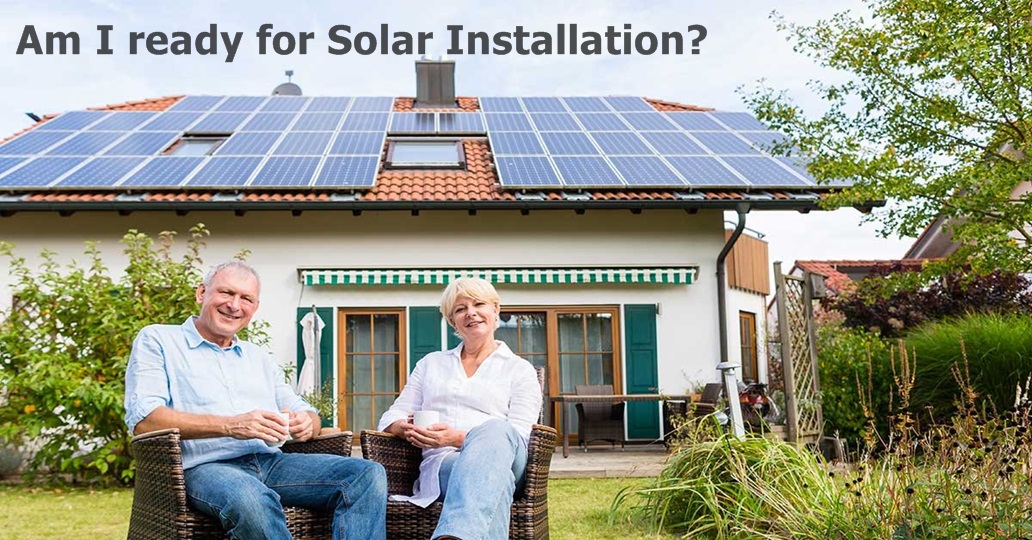
Am I ready for Solar Installations?

Can I afford to go solar?

If you can afford your monthly electric bill, then you can probably afford to go solar! In few years past, solar was a big investment, and those who can invest large amount of money to contribute could go solar.

Now-a-days, things have been changed! Most homeowners and businesses can go solar with accessible low and zero-down financing options like PPA, solar leases, etc. Whether your property is urban or suburban, you can convert to solar is in affordable price. It will give you savings in the long run.

  • Solar is smart investment with an impressive ROI.
  • The vast majority who goes for solar are basically motivated by the budgetary advantages.
  • You can save money on your electricity bill using solar.
  • Solar systems needs a little amount as it’s the maintenance cost that means it has no maintenance cost on recurring basis.
  • According to the report, solar system increases property value.

Is my roof suitable for solar panels?

The best roof for solar panel is between 30-40°. However, the point of the rooftop can fall outside this range and generate electricity viably. Solar panel can absorb sunlight horizontally. In any case, solar panel which is more beneath 12° from horizontal, it won’t have the option to self-clean and may become less effective if it is dirty.

Checking the feasibility of setting up solar panel on the rooftop is one of the most significant parts of planning a solar system. It is significant because inefficient installation could radically expand your installation and maintenance cost. Even roofs which don’t fit the perfect requirements can still be suitable for solar panels. But you will find that solar installers who will advise the best way to maximise energy generation, and can recommend extra advance technologies you can use to boost your power generation.

There are 4 distinct aspects to consider while feasibility of setting up solar panels on your rooftop. They are: type of rooftop, age of the rooftop, choosing the right installer, Roof direction.

Type of Rooftop

Solar panels can be installed on practically a wide range of rooftops. The complexities engaged with introducing solar panels may vary with various rooftops. The most popular rooftop type which is appropriate for solar installation is metal roof. It has few advantages for rooftop solar: durability, lightness, energy efficiency etc. But composite roof and tile roof is the most common type of roof for solar. But Ceramic tiled and wooden shake rooftops are difficult to work for solar installer.

Age of Roof

If your rooftop is more than 25-30 years old, we ensure to replace the rooftop before installing solar system. If your roof tiles are cracked or there is a leak then it would be better to replace it before installation. Otherwise, your installation process will be complex and costly.

Choosing the right installer

Whatever rooftop you’ll have, it’s more important to have a right solar installer. It’s a challenging part of buying solar system. Your solar installer should be experienced and well-trained staff. An expert solar installer can advise the best way where your system performs efficiently to provide high ROI.

Roof Direction

The best kind of rooftop for solar panel is a south facing rooftop as they will in general the more power from solar panel. South facing rooftop panels see the sun when it is at its most intense for the longest time frame. That’s why it produces the most energy.

If you want to install solar panel on your roof, you just send us a quick enquiry today. We will provide expert solar installer to check your roof and give you proper projection for how much electricity you’ll generate in a year.

What size solar energy system should I get?

The size of your solar panel will depend upon several factors and no one size fit — how much electricity you use average per day, the weather conditions where you live etc. Next, you have to get a grip of the solar based discounts and incentives that apply to your region. Another thing is how many kWh’s of power do you get per day from each kW of solar that you install. The answer of this question varies depending upon your area.

According to the report, in NSW a 5kW solar system can produce enough energy to power your home, yet you might not have enough rooftop space for a system of that size. Solar panels for home come in the standard components of 1.70 m × 1.00 m, that is around 1.7m2 for each panel installed. The wattage o/p (W) of the panels will probably differ somewhere in the range of 250W and 330W for an advanced module.

As a guide, you’ll need 4 × 250W panels, or 3 × 330W for each 1kW of your solar system. If you’re considering a 5kW system, that’s somewhere in range of 15 and 20 solar panels that will require anywhere between 25.5 — 34m2 of rooftop space.

Do I need to replace my roof before installing solar?

If it is evaluated that your rooftop need to be replaced before going to install solar then you should replace your roof as priority basis. Solar panels are more durable than your roofing materials. If your rooftop is somewhere in the range of five and 10 years, it’s a smart decision to get a specialist out there to survey. Subsequently, when you pair solar with a rooftop substitution, the panels really expand the lifetime of the part of the rooftop that they cover.

The other advantage of blending sun oriented and a rooftop substitution together is that in case you’re introducing on another rooftop, it’s impossible you’ll have to re-rooftop during the lifetime of the framework. This can help set aside your cash over the long haul, since you can keep away from the expenses related with expelling and reinstalling the sun powered boards on your rooftop.

The other advantage of pairing solar and a rooftop replacement together is that if you’re installing on a new roof, it’s unlikely you’ll need to re-roof during the lifetime of the system. This can help to save you money in the long run. Because you can avoid the expenses related with removing and reinstalling the solar panels on your roof.

How much does it cost solar panels in Australia?

Is that solar panel a worth buying option for home power consumption?

The answer is always yes. So what is the cost of installation for solar panels in Australia? At the beginning it can be expensive, but these onetime investments will save you on electricity for next couple of years. It will payback your money in next five to seven years and will continue even after this period. As the production cost of Solar panels in Australia dropped significantly, it affects the cost of installation of Solar PV System. In Australia, a good quality 3kW system will cost between $5,000 — $8,000 due to quality differences.

What is solar power?

Solar power is the utilisation of the sun’s vitality either straightforwardly as warm vitality (heat) or using photovoltaic (PV) cells in sun oriented boards and directly in photovoltaic (PV) glass to create solar power. That’s why it can be treated as solar photovoltaic (PV) systems. Generally the solar panels are mounted on the ground or it can be roof-mounted. After collecting the solar energy from the solar panels, it has been converted into alternate current (AC) through a solar power compatible Inverter. The battery has attached with this system to store the current to use that as and when required.

Why should you consider solar power as the most efficient and affordable power supply system?

With environmental change compromising the planet and continually rising power costs undermining your wallet, there’s no better time to do the change to a sunlight based photovoltaic (PV) framework or Solar Power system. As innovation improves, Solar PVS are ending up progressively reasonable and proficient, making them significantly more of an appealing alternative for your home’s vitality needs. If we want to consider the pricing and affordability of solar power to measure its efficiency, we need to break the periods into three stages. Solar panels were so much expensive and the payback period was much longer till 2011. After 2011, the pricing has dropped miraculously. And today, it is much more affordable to the home solar power needs or even to the commercial needs.

How much does solar power cost in Australia?

Solar Panels have likewise improved proficiency and unwavering quality. Previously in Australia, solar panel boards were costly and most mortgage holders purchased littler frameworks up to 2kW. Today, a 5kW framework is about a similar cost as a 2kW framework was before 2011 and is a superior framework to have on the grounds that it can represent most if not the majority of your vitality prerequisites.

Solar Panel snow issues are normally negligible. In any case, there are a couple of things that you should think about the implications of winter climate as you consider installing a solar system on your home:

  • Solar panels are designed to hold up under a specific measure of weight – and snow will generally not be heavy enough to cause issues. All solar panels have to do weight tests to evaluate strength and quality. Rating differs by the panel to panel. The high-pressure rating indicates that the panels are better at withstanding the weight of snow.
  • If snow covers your panels, they can’t produce power –it’s easy to wipe them off with the right types of equipment. Solar panels need sunlight to generate power. If your solar panels are covered with snow, then it can’t generate electricity. You can control the situation, but it can take time. If you’ll get solar panel snow rake or any similar tool for solar panel snow removal that won’t damage the panel and you can clean off snow from your panel.

How to choose the right size Solar PV system for you?

If you are thinking to install new solar panel system for your home or commercial place, and about to choose the right size for your Solar PV system, you need to think & consider the following:

  • Collect your past year’s electricity bills
  • Calculate average consumption of your monthly electricity usage
  • Include the kWh s for each of the year and calculate that number by 12 to decide your normal monthly vitality utilisation.
  • Partition the monthly figure by 30 to decide your everyday kWh utilisation.

To compute the size of your sunlight based Photo Voltaic (PV) framework, take your every day kWh vitality prerequisite and partition by your pinnacle sun-hours to get the kW yield you need. At that point isolate the kW yield by your board’s effectiveness to get the all out number of sun oriented boards for your framework.

After you know the quantity of Solar Panels you need, the subsequent stage is to decide whether you can fit them all on your rooftop, and on the off chance that you have the correct sort of rooftop to mount boards on.

How to determine perfect Isolation of Your Solar Power System?

Find right Solar Panel Isolation table on the web to decide the Isolation, the normal number of hours out of each day that the sun produces top daylight (or an aggregation of all daylight proportional to that measure of pinnacle daylight), for your area.

Discover the closest city to you on the table and record the normal every day figure. To decide explicit isolation information for singular days of the year, utilise NASA’s Atmosphere-Ocean Model. (http://data.giss.nasa.gov/ar5/srlocat.html).

The best way you can determine what you have exactly needed, is to contact the Solar Panel installation company nearby your area. If you are based in Penrith and looking for Solar Panels, you can contact us (Solarmanaustralia) to consult more.

How to choose the right Solar Panel for you?

  • Measure how much space you need to mount your Solar Panel System.
  • Choose a financial limit for your Solar Power framework. Discover a framework that fulfils your capacity necessities, yet fits inside your space limitations.
  • This will decide whether you need a rooftop mounted or ground-mounted framework, and in case you’re qualified for a sun based rooftop shingle framework.

When buying a PV framework remember that guarantees shift between 10 and 25 years. On the off chance that you don’t have the assets to buy a more drawn out enduring framework, ensure it will in any event restitution your underlying interest in vitality investment funds. Additionally, make sure to investigate the numerous motivating forces that your administration offers. Change to sun based and each time you gaze toward the sun you’ll have one more motivation to express gratitude toward it.

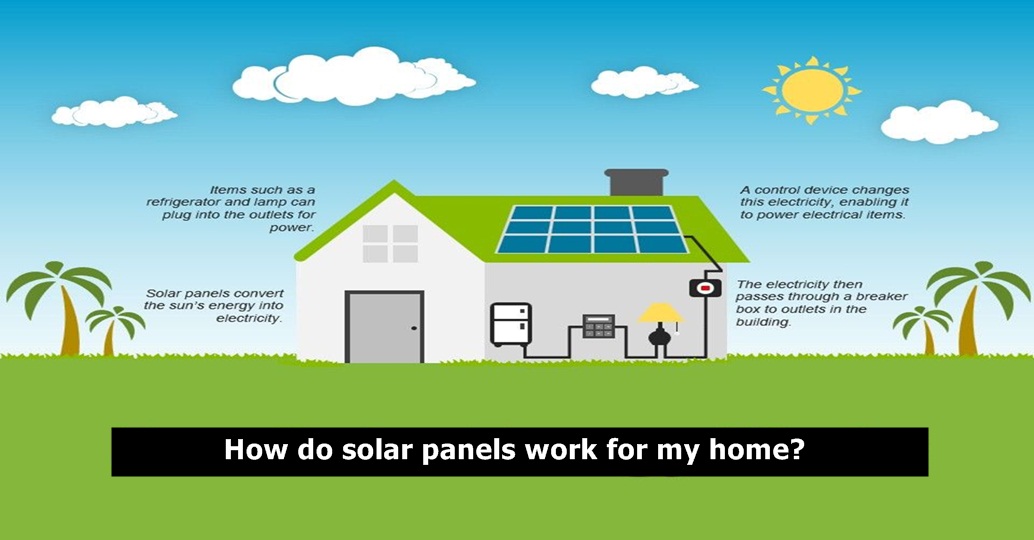
How do solar panels work for my home?

Solar panel absorbs sunlight with photo-voltaic cells and then generates direct current (DC) energy. Afterward, it converts to usable Alternate Current (AC) energy with the assistance of inverter technology. AC current flows through the home’s electrical board and powering electronic gadgets. Excess power generated by the solar panel is sent to the electric grid. Thus Solar Panel works for your home.

Few reasons to explore the benefits of using solar power

1. How do solar photovoltaic (PV) panels work?

The solar photovoltaic cells in your solar panel are the components that convert sunlight into energy. When you install the solar panel on your home, the PV cells convert sunlight into direct current (DC.) Then an inverter associated with the system converts the direct current into Alternate Current (AC). This sort of current controls your home appliances. This power goes through your electrical panel box. You can run your whole house on sun based power just like the way of power taken from the grid.

Most solar systems of residential places are as yet associated with the grid. This is to take into consideration continuous power when you need more power to your home (e.g., on cloudy days or during the night). When you create enough energy from your solar panels that you have left it “extra”, it will get sent back to the grid and you will get credit for this energy contribution. This procedure is known as “net metering”.

In the procedure of solar energy transformation, the sun discharges photons. When sunlight hits the photovoltaic panels, electrons are discharged, which makes direct current. Solar panels are comprised of many photovoltaic cells, which are frequently made out of silicon as the semiconductor.

The power generation depends on the production of an electric field. An electric field is made when inverse charges interact. The silicon in the panel emits both positive and negative energy to make this electric field. At the point when sunlight hits the cells, electrons are discharged from the movement of the molecules. The interaction between the photons discharged from the sun and the electrons discharged from the solar-based cell creates direct current. Metal transmitter plates inside the solar panel allow the electric flow to go through wires. When moving openly through the wires, it’ll power your house and home appliances.

Many solar photovoltaic cells are wired together to shape a module which is called a panel. These panels are associated together to shape the main body of your solar energy system. Having enough solar panels installed in your home or business would then be able to power most of your space. Obviously it will differ based on your atmosphere conditions, a measure of absorbing sunlight, and the productivity of the solar panel you install.

2. Do my solar panels produce power when the sun isn’t shining?

Solar panels generate electricity for your home in the presence of sunlight. The power generation starts when the sun rises and stops when the sunsets. It does not work in darkness. So power generation will be less in the early morning, higest around early afternoon and afterward lesser at night. This irregularity happens because of the variety in solar-based radiation which fluctuates over the day, as the radiation from the sun is highest during the early afternoon and relatively lower during early morning and night. The panels generate comparatively lower power during cloudy days. Because of lower solar radiation, the units generated will be lower than the units generated during clear sky days. This solar power feeds electricity into your home. If it is producing more electricity than your requirement, then excess electricity is fed back to the grid.

3. What happens if there is snow on solar panels?

Solar panels are the component that converts sunlight into energy. If snow covers your solar panels, it can’t generate electricity. Snow isn’t enough to cause the structural issue with your panels. It’s easy to clean off with the right pieces of equipment.

Solar Panel snow issues are normally negligible. In any case, there are a couple of things that you should think about the implications of winter climate as you consider installing a solar system on your home:

  • Solar panels are designed to hold up under a specific measure of weight – and snow will generally not be heavy enough to cause issues. All solar panels have to do weight tests to evaluate strength and quality. Rating differs by the panel to panel. The high-pressure rating indicates that the panels are better at withstanding the weight of snow.
  • If snow covers your panels, they can’t produce power –it’s easy to wipe them off with the right types of equipment. Solar panels need sunlight to generate power. If your solar panels are covered with snow, then it can’t generate electricity. You can control the situation, but it can take time. If you’ll get solar panel snow rake or any similar tool for solar panel snow removal that won’t damage the panel and you can clean off snow from your panel.

4. Can I go off-grid with solar panels?

Living off-grid– i.e., living free of the main grid that can appear to be exceptionally engaging when you consider consistently expanding power costs.

There are a few regions in which off-grid is a lack of choice. But for some individuals, going off-grid is just a misconception. Even off-grid living presently reaches the span of numerous Aussies.

When you go off-grid, you take out electric bills. If you reduce your power usage, when associated around seventy-five percent of your bills are network and generation costs. Living off-grid implies you can stay away from both the network and use expenses of power.

You can protect yourself from blackouts and power outages when you’re off-grid. Spontaneous blackouts specifically make the mess up; even you would have no idea when the power returns on. With an off-grid system, this is something you don’t have to stress over.

You can reduce carbon and other pollutant emissions when off-grid. That means you can do a bit for your environmental benefits which are important reasons for Australians.

In some rural areas, there are no nearby electrical lines. Even grid connections can be expensive also. An off-grid can be a feasible option and wipe out ongoing costs too.

It is possible to go off-grid- with energy storage solution along with solar installation you will get two options-electric generation and excess power storage. You can store the excess solar power for later use.

5. Will I still receive an electric bill if I have solar panels?

You will even now get an electric bill when you install solar panels. Significantly, the bill may not request to pay anything. It may basically show how your use was counterbalanced by net metering credits for the month. For the situation where you give more power to the grid than you pull, as a rule, your utility will turn over your unused bill credits to the following month for you to take the advantage. Installing solar panels will lead to lower electric bill charges monthly. Even some homeowners can eliminate their monthly electric bill.

6. Do solar panels work in a blackout?

Solar photovoltaic panels absorb solar energy and convert it to usable AC energy in your home. If you’re thinking about installing a solar system in a blackout, there are few facts to consider.

Solar systems are integrated with the grid. During the sunlight, panels will produce energy. The excess energy will go into the utility grid and you will get “net metering” credits for this. Your panels won’t produce energy around the evening time. At this time, you will utilize the credits which you created during the day. The drawback of being associated with the grid is that if there is a power outage (blackout) your solar system will not work. All grid-tied solar systems are introduced with an automatic shut off switch which turns off your solar system in a power blackout. But it has a solution with an inverter that can manage all the functions required to run your electrical system.

7. How much will solar panel maintenance cost?

The average expense to clean and maintain solar panels is $150 to $330. Homeowners spend an average of $150 to clean their solar panels. Solar panel maintenance cost depends on several factors such as roof slant, home height, system size, etc. Professional solar cleaning organizations charge $15 to $35 per panel. A few organizations charge a level rate.

Why should I go solar?

There are many reasons to go solar. Solar power is an advanced form of renewable energy. Most of the general crowds are not aware of solar usage for residential and commercial purposes. Solar power is an environment-friendly, economic, great return of investment.

Few reasons to explore the benefits of using solar power

1. What are the financial benefits of solar energy?

Solar energy is one of the best and fastest advancing forms of renewable energy. It is non-polluting and easy to generate large scale electricity with low utility bills for sustainable development. It helps to avoid global-warming and save electrical expenses. Few financial benefits of solar energy:

Power Savings

With a solar based power framework (Solar Panels), you keep away from regular rate hikes related with petroleum derivatives. The average household power bill for NSW, VIC and QLD is around $1,500 to $1,700 a year. The average electricity bill in South Australia is set to be $2,300 in 2018. At a normal utility pace of $0.16 per kWh, you’ll save $1,344 in the first year if you buy the solar system. If you opt to have a solar-based Panel installed, you save money on your electric bills. Even when you installed solar panel produces more power than your requirement, that power is sent back to the grid and you will get credit for this energy contribution.

Smart Incentives

Incentives are remarkable as the individual expresses that execute them. Features of incentives depend on whether the solar system is for commercial or residential purposes. States with incentives forces commonly have discount based incentives, production-based incentives, or a blend of the two, all of which makes the advantages of solar energy more accessible for the normal resident. The national government likewise offers expense credits and awards for renewable energy systems.

Expanded Property Value

A frequently overlooked budgetary advantage of solar power is the worth it adds to a home. According to research led by the Lawrence Berkeley National Laboratory, homebuyers are happy to pay a premium of $15,000 for homes with a normal estimated solar power system. Joined with the 30 percent expense credit, the reasonable expense of power, and the way that panels can provide ROI approaching generally a large portion of the expense of installation, solar essentially pays for itself.

Solar Makes Employments and supports families

When your community gets employed, then your society will be benefited. According to the census, solar energy adds jobs 17 times faster than the overall economy in Australia. The Australia solar workforce expanded 168% in the previous seven years. In 2010, the industry employed 93,000 individuals. In 2018, the quantity of solar-powered occupations expanded to more than 242,000, and further development is expected. The best thing is these solar jobs can’t be outsourced, so they are a contributor to our economy.

2. What are the environmental benefits of solar energy?

Reduces Air Pollution

Non-renewable energy sources make plenty of poisons. Electricity generation from fossil fuels can generate carbon dioxide and other harmful gases. So we breathe from the lower quality airs on a daily basis. Smog is awful for nature; it’s awful for our health. Breathing poor quality of air on a daily basis can cause the possibilities of suffering from asthma, allergies, bronchitis, pneumonia, headaches, anxiety, heart attacks, and even some cancers.A solar panel helps to get rid of air pollution. Utilizing Solar power, like other renewable energy resources, you will get many environmental and health benefits. Solar energy generates more electricity reducing harmful gas emissions. If you install solar panels at your home or your commercial places, you will get clean solar power. Clean solar power means less toxic emissions from fossil fuels into our air.

Reduce Water Usage

If your energy doesn’t utilize petroleum derivatives to control itself, it most likely uses a type of water. Hydropower and nuclear energy both use a lot of water to create energy. Water is used for cooling generators, processing, and refining fuel and transporting fuel through pipes, etc. However, generating power through solar panels, there are no uses of water. The activity of solar-powered photovoltaic cells doesn’t require water to create power. The rainwater water is required to clean the panels!

Reduces our reliance on Nonrenewable Energy Sources

We previously mentioned how a few people appreciate solar energy. They actually like to be energy independent. Solar energy can help to reduce our dependency on nonrenewable energy sources. There are a few reasons behind this. The first and foremost reason is that nonrenewable energy sources create a lot of air pollutants. On the other side, fossil fuels will run out because nonrenewable assets are nonrenewable in light of the fact that they will, in the end, run out. Reducing our dependence on these nonrenewable assets, we should take advantage of the advanced form of renewable energy, for example, solar energy. It makes lower energy costs, decreased green gas emissions, and a sustainable power source in the future.

Improves Human Health

Fossil fuels create a lot of air pollutants. It can generate carbon dioxide and other harmful gases. So we breathe from the lower quality airs on a daily basis. Breathing poor quality of air arises many severe diseases like asthma and allergies, bronchitis, pneumonia, headaches, anxiety, heart attacks, and even some cancers. If we use solar energy, we can avoid health problems. The solar panel generates more electricity without producing any kind of harmful emissions. So we’ll get enough health benefits.

Climate Changes

The arrival of harmful gases into the climate, for example, carbon dioxide, methane, and nitrous oxide don’t simply add to air contamination, it also enhances the greenhouse effect. The greenhouse effect warms the Earth’s surface to a livable temperature, human activities, for example, the consumption of petroleum products has expanded the measure of greenhouse gases in our environment. It leads to the greenhouse effect, which is warming our earth quicker than before. For this reason, abnormal climate change arises, for example, flooding, violent winds, storms, outrageous warmth and dry season, etc. Solar Panel is the way by which we can prevent the effect of climate changes. By creating solar energy we can reduce greenhouse gas emissions. So it can help to slow down the effect of climate change.

3. How do I find out how much I pay for electricity?

As per recent research it shows, on an average household power bill for NSW is around $1,500 to $1,700 a year. If you look into a few of your previous electricity bills, you can identify your actual consumption. And here is a big question you should have on your mind that, how much your Electric Bill will be after installing a Home Solar System in Australia. The answer is it depends on a few aspects, like how much energy produced by your Solar Installation, total energy consumption by the household, and the local electricity rate.

4. What is solar net metering?

Net metering is the billing system that allows for residential and commercial customers who generate excess electricity with their solar panel systems to sell the electricity and sending it back to the grid. Many people who’re interested to go for solar, “Net Metering” is the common term for them. Solar net metering has several benefits. Net metering can save residential holders many dollars on their service charges each year. So it’s the primary reason to go for solar in a cost-effective way. There’s another benefit for net metering. Since solar is producing power close to the point where it will be used, this decreases strain on the grid’s distribution and transmission foundation. It also reduces energy loss from sending voltage numerous miles from the closest power plant.

5. How does solar impact my property values?

Savvy homeowners, potential buyers, and appraisers know that property values are directly proportional to the number of solar panels installed on the real estate market. There are numerous advantages to solar power at home. The most significant one is that the solar panel helps to reduce green gas emissions. It is a more important step for you and your future generations. It is the most important commitment to have a sustainable house. Next, you can reduce your electricity bill by a few hundred dollars every year consistently. Additionally, many states offer solar credits that will enable you to take care of the establishment expense of solar panels, different organizations offer to finance or renting of their items to help you through the procedure. A few experts assert that introducing solar panels would make your home increasingly favourable to potential purchasers. They ensure that when you choose to sell, your home would sell quicker than others without solar power. Cost of Solar clarifies each extra $1 in energy savings (from your solar-based establishment) adds $20 to your home’s complete worth. Homeowners can get detailed clarification of how much solar impact the property values.

Newsletter

Signup for our Newsletter to get the latest news, tips, community updates and more into your inbox.